


The Capital Gains Trap: Why Retirees May Pay More Than Expected on Roth Conversions
In my experience Googling financial planning questions, the answer is usually an overused rule of thumb. Roth conversions are no exception.
For example, I recently asked AI:
"I am a retired 60-year-old with a large IRA balance. How much should I convert to my Roth?"
Part of the response was:
- Fill up the 24% federal tax bracket each year.
- Sometimes fill up the 32% bracket if future RMDs are projected to push income even higher.
On the surface, that sounds reasonable. Although it ignores many of the factors that will determine how much tax you pay.
One of the biggest? … Capital gains!
Wait… Roth Conversions Are Ordinary Income
If Roth conversions are taxed as ordinary income, then how do they possibly affect capital gains taxes?
Because long-term capital gains don't exist in a vacuum.
Your taxable income is made up of both ordinary income and capital gains. Your total taxable income determines whether you pay capital gains at the 0%, 15% or 20% rate.
This is where retirees can get caught by surprise. Many retirees can become used to realizing gains with little or no tax consequence because a significant portion of long-term capital gains may qualify for the 0% capital gains rate.
Then they complete a Roth conversion.
The Roth conversion will increase ordinary income. That additional income increases taxable income, which can then push capital gains that were previously taxed at 0% into the 15% capital gains bracket. Suddenly, that Roth conversion is not only generating ordinary income tax. It is also increasing taxes on capital gains.
Taxes Rarely Move One Lever at a Time
Capital gains are only one of many examples.
To name a few, additional ordinary income can also:
- Cause more Social Security benefits to become taxable
- Cause more investment income to become subject to the 3.8% Net Investment Income Tax (NIIT)
- Increase state income taxes
- Decrease or even eliminate your deductions and credits
- Increase Medicare IRMAA surcharges
“What happens to your next dollar of income?” is often a much more important question than, "What bracket am I in?"
A Client Example
The chart below illustrates this concept.
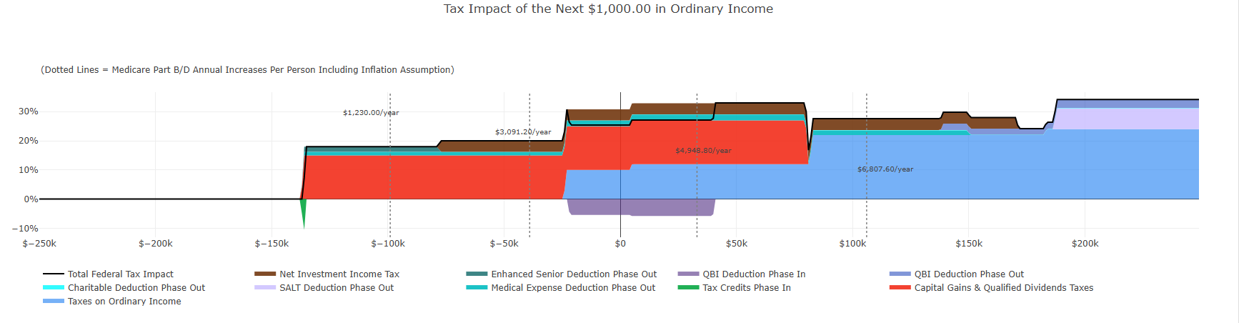
Client background:
- The client has $249,289.66 of taxable income.
- Only $21,313.66 of that income is ordinary income.
What you are looking at:
- The middle "$0" represents no change in ordinary income.
- Moving to the right represents increasing ordinary income, such as through a Roth conversion.
- Moving to the left represents decreasing ordinary income.
- The blue represents their marginal ordinary income tax bracket.
For example, the "$50k" point shows the impact of adding $50,000 of ordinary income through a Roth conversion.
The "Pause Zone"
In this scenario, the client lands in what I'm coining the Pause Zone (trademark pending!) (kidding).
Why?
Adding anywhere from $1 to $80,000 of ordinary income creates an unusually high tax cost. At the highest range, the next dollar of income is taxed at roughly 33%. An $80,000 Roth conversion would increase total taxes by roughly $22,451, producing a “true” effective tax rate of about 28% on the conversion amount.
What's remarkable is that the client only gets up to the 12% Ordinary Income tax bracket.
The tax cost hike comes from the interaction of a few tax rules:
- Long-term capital gains moving into the 15% bracket
- Net Investment Income Tax
- Other tax-related phase-ins and interactions
That's how strange (and fun) tax planning can be.
The Real Point
The point isn't that Roth conversions are bad - far from it.
The lesson is that the ordinary income tax bracket, not the overall tax rate, determines the tax applied to each additional dollar of income. For retirees with any capital gains, investment income, Social Security benefits, or state income tax (to name a few factors…), a Roth conversion can have effects that aren't obvious at first glance.
That's why a Roth conversion analysis should never be as simple as, "Fill up the 24% federal tax bracket each year.”
The better question is:
What is the “True” Marginal Tax Rate on the Next Dollar of Conversion?
Sometimes the answer will lead to a large conversion, sometimes it will support a smaller one, and sometimes it will tell you to pause entirely.
You also must consider your “true” marginal tax rate today with your “true” marginal tax in the future (you OR your beneficiaries). But that's a whole other can of worms for another day.
As with most things in financial planning, the answer is: it depends.
Not very black or white of an answer, I know.
But that's financial planning and taxes for you.
SSB Wealth Management, Inc., d/b/a Rembert Pendleton Jackson (“RPJ”) offers investment advisory services and is registered with the U.S. Securities and Exchange Commission (“SEC”). SEC registration does not constitute an endorsement of the firm by the SEC nor does it indicate that the firm has attained a particular level of skill or ability. You should carefully read and review all information provided by RPJ, including Form ADV Part 1A, Part 2A brochure and all supplements, and Form CRS.
This information is intended to be educational in nature, and not as a recommendation of any particular strategy, approach, product or concept. These materials are not intended as any form of substitute for individualized investment advice. The discussion is general in nature, and therefore not intended to recommend or endorse any asset class, security, or technical aspect of any security for the purpose of allowing a reader to use the approach on their own. You should not treat these materials as advice in relation to legal, taxation, or investment matters.