


Retirement Income Planning
As professionals advance through their careers, there comes a point where most will need to figure out how to afford retirement. This is where retirement income planning takes center stage.
Retirement income planning is the act of replacing a paycheck earned during working years with a stable source of income in retirement. The aim is to meet living expenses and goals.
Notable Income Sources:
As the table below illustrates, not all retirement income sources are created equal.
Non-Portfolio Income Sources
Conditional Income Sources
Retirement Assets and Savings
Social Security
Workplace Pensions
Annuities
Part time work
Rental income
Non-qualified plan payouts
Inheritances
Sales of business interests
Workplace plans
Brokerage accounts
IRAs
Savings
- Non-Portfolio: These income sources tend to be stable and are typically designed to last throughout one’s retirement.
- Conditional: These income sources can be very influential but are difficult to project with certainty. For example, an owner of a closely held business will need to find a suitable buyer if they plan to sell their interests to fund retirement.
- Retirement Assets and Savings: These are often converted to income by selling investments.
Planning for Retirement Expenses:
Before developing a plan that incorporates these income sources, hopeful retirees will need to evaluate both quantitative and qualitative factors to estimate their retirement income needs.
Examples:
- Financial Statements: Reviewing cash flow and net worth can help determine spending needs and identify assets and liabilities that will be in retirement.
- Family History: Planning for medical costs and long-term care in some cases.
- Goals: Preferred lifestyle in retirement and legacy.
- Tax implications: Electing benefits and the order of distributions from accounts.
Retirement Expenses Over Time:
Retirement expenses can be hard to pinpoint because spending needs and desires often change as people age.
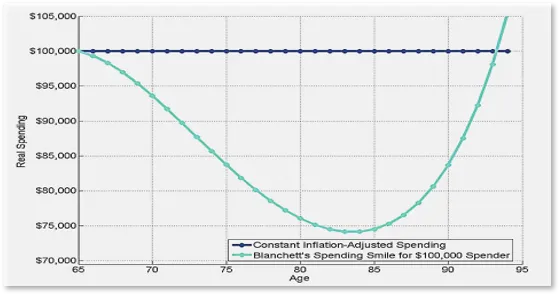
In his article titled “What Is the Retirement Spending Smile?” retirement researcher, Dr. Wade Pfau, highlighted David Blanchett’s work on retirement consumption over time across various household spending levels.
While the blue line on the graph projects retirement expenses over time using a constant inflation-adjusted rate, David’s green line shows that spending keeps up with inflation in the early years of retirement, tapers off in the middle period, and comes roaring back in the later stages. This creates a smile effect when plotted on a graph.
David’s research revealed that younger retirees tend to be more active and indulge in bucket list activities that can be expensive. These activities tend to slow down over time until other expenditures like health costs take precedence. Regardless of the method used to project spending in retirement, research indicates that retirees need income sources that can keep up with inflation and sustain long-term growth.
Retirement Readiness:
After clarifying spending needs, goals, and income sources, pre-retirees will need to make a preliminary calculation to determine an initial amount needed to retire. Assumptions used in the calculations need to be reasonable and answer the following questions:
- Rate of return: How much will my investments earn in retirement?
- Longevity: Will my money last in retirement as anticipated?
- Inflation: How much will my expenses grow throughout retirement?
- Income Sources: Do I have more than my projected expenses?
Ultimately, the goal at this stage is to have enough projected income to comfortably replace projected expenses. If there is a short fall, strategies need to be formed to address the issue.
Like assumptions, strategies such as saving more, reducing spending, and working longer need to be feasible for a retirement income plan to work for an individual.
Stress Testing:
Having more income than projected expenses is the goal, but a retirement income plan needs to be stress tested before full implementation. After all, life does not shake out exactly as projected.
There needs to be enough saved to handle unexpected events such as market downturns, forced early retirement, premature death of a spouse, etc. If a plan passes through this stage, then a strategy to convert assets into income can start to take shape.
Income Distributions:
This stage is all about establishing ways to create a paycheck and understanding the trade-offs that come with each decision. Retirees often have to juggle when and how to enable multiple sources of income.
Common Examples:
- Early Retirement: Retirees will often need to live on portfolio income before they are eligible to claim Social Security or withdraw from their retirement accounts. The more withdrawals from a portfolio, the less that can be left to heirs.
- Social Security: Opting to elect benefits early will result in more paychecks overall in retirement but at a reduced benefit amount compared to full retirement age.
- Inheritance: A full distribution from an asset that can be taxed like a traditional IRA may not be prudent to do all at once. It often makes sense to spread out distributions to smooth out taxes.
Retirement income planning requires lots of organization upfront and constant monitoring during retirement, but a well-defined strategy will help a retiree know where to access income they were accustomed to while working.
As always, we are here to help you form your own plan, which should be as unique as the life you led before retirement!